October 2026 Hay Report
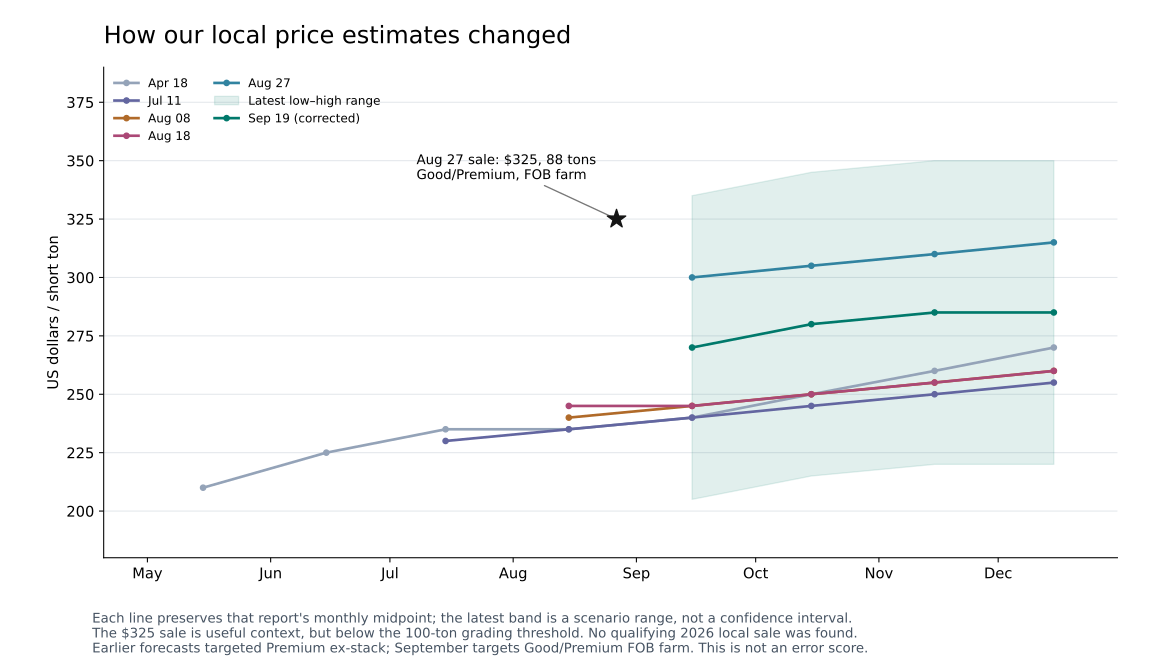
Basis: SE Colorado Good/Premium commercial large-square alfalfa, $/ton at origin (FOB) · Supersedes: the Sep 19 grid · Method: three parallel data pulls (USDA hay reports for seven states; water, rain, drought and El Niño; USDA prices and costs), every raw file saved, every load-bearing number checked a second way; an outside review of the reasoning before publication. Confidence on every forecast row is LOW (our rule L9 until we have twenty graded local outcomes). Full analysis: research/20. How sure we are, and why: research/21. The outside review: review_2026-10-02.md (17 findings, all fixed before publication).
Bottom line
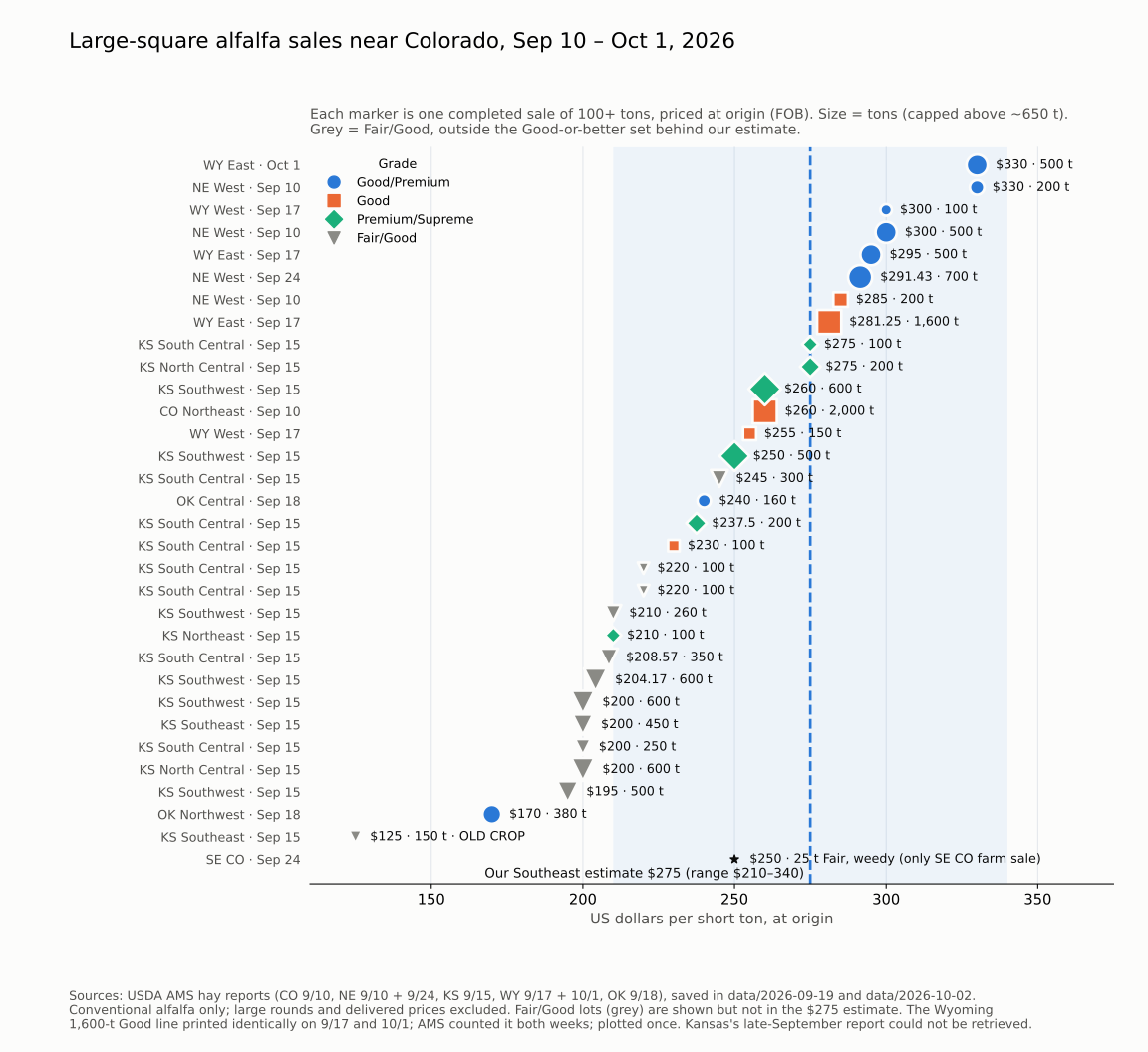
The price held at about $275 a ton. No Southeast Colorado sale of 100+ tons of Good-or-better large squares printed this cycle (that happens in about 2.5% of reports). Our estimate comes from 19 sales of 100+ tons of Good-or-better large squares in Colorado and the surrounding states since Sep 10, priced at origin. Eight reasonable ways of averaging them land between $262 and $308; the middle of those is $273.5, which we round to $275 for Good/Premium, ~$270 for Good, range $210–340. That is $5 above the Sep 19 estimate, which is noise inside the range. The biggest swing factor is geography: northern sales (Colorado, Nebraska, Wyoming) average $283, Kansas and Oklahoma $239.
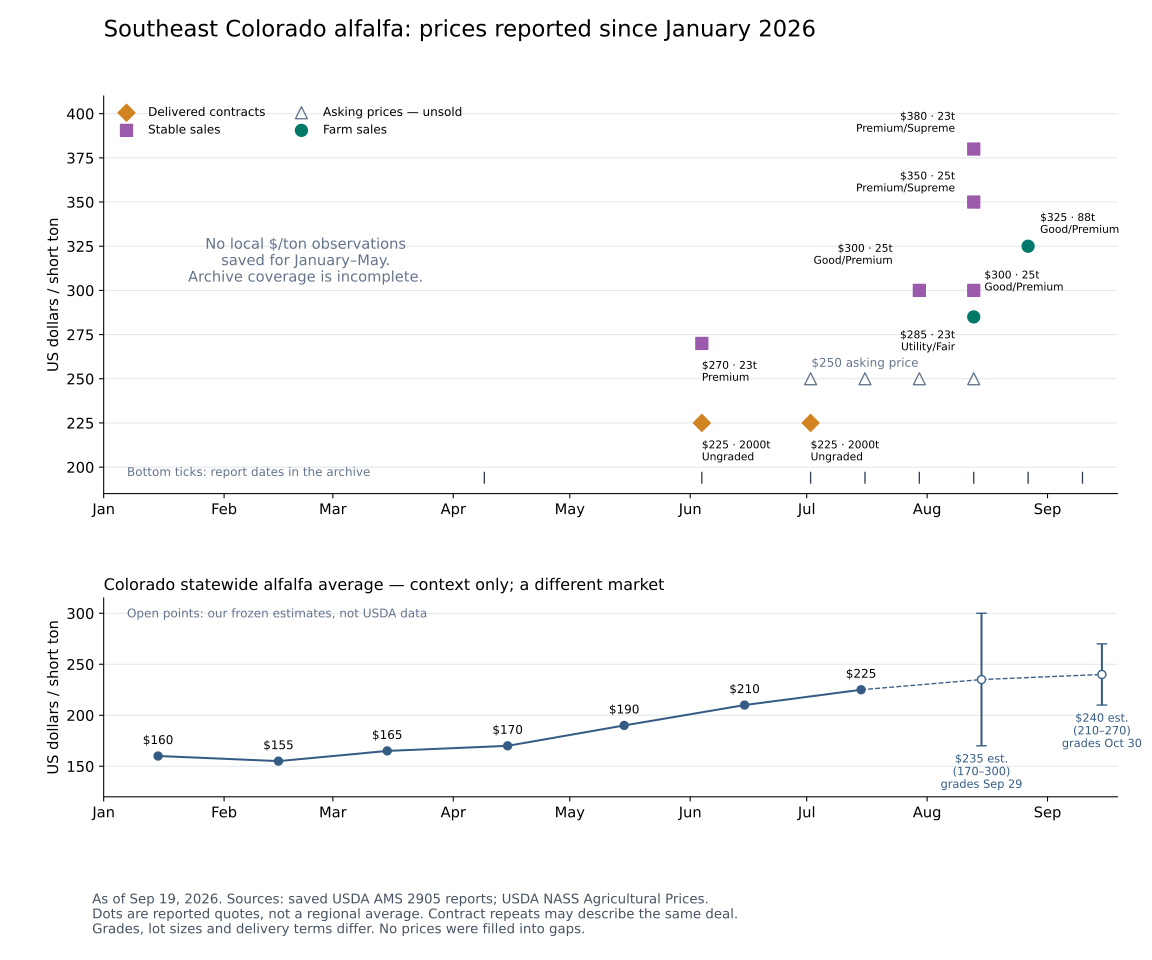
Two sales speak to the seller's hay. On Sep 24, 25 tons of Fair-grade, weedy, third-cut new-crop alfalfa in 3x4 bales sold at $250 at a Southeast Colorado farm — the closest sale on location. On Sep 15 in southeast Kansas, 150 tons of Fair/Good old-crop 3x4s sold at $125, while 450 tons of the same grade without the old-crop label sold at $200 in the same report — the closest sale on crop age, and a warning.
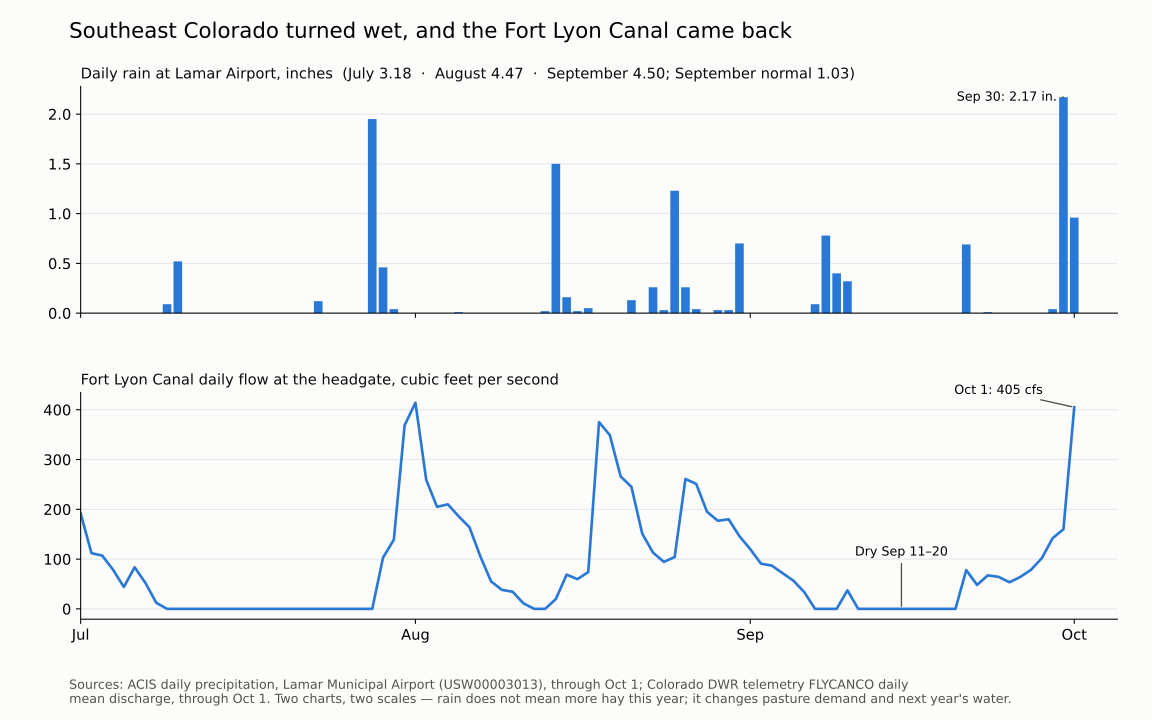
The weather flipped. Lamar Airport got 4.50" of rain in September (normal 1.03"; 2.17" of it on Sep 30), after 4.47" in August, then 0.96" more on Oct 1. Bent County went from 61% severe drought on Sep 8 to none on the Sep 29 map, before the latest storm. The Fort Lyon Canal, dry Sep 11–20, is running at about 370–400 cfs. Oklahoma and Texas went the other way: drought worse, ranchers already feeding hay. We have no measured skill at turning weather into price. We still cut the winter lift because of the rain; that is our judgment, not a measured effect, and it is logged as an exception to our own rule. The weather matters more for a seller's stack than for the price (see below).
Report card
Four rows resolved. Scores are computed from the ledger, never typed.
| # | Prediction | Outcome |
|---|---|---|
| 17 | Colorado alfalfa August state price $235 (170–300) | HIT — $235 |
| 18 | Colorado all-hay August $230 (165–295) | HIT — $231 |
| 19 | Kansas alfalfa August $155 (90–220) | HIT — $127 (point off by $28) |
| 28 | No Southeast per-ton farm sale in the Sep 24 report | MISS — 25 t Fair at $250 |
Standing record: 9 of 19 two-sided ranges contained the outcome (+2 NEAR). The economically central rows are 2-for-7. On the August state prices, our judgment beat plain persistence from the data we had when we made the calls (average miss $9.7 vs $17.0), but all of our error was Kansas. The Kansas state average has moved $1 a month for four months while Kansas cash traded $200–275; the state average is a different, cheaper market, not a lagging copy of cash. The next Kansas row is pure persistence for that reason. Six new predictions (#40–45) are frozen for November releases; two are flagged as low-information (near-certain), and a seventh was withdrawn before release as padding.
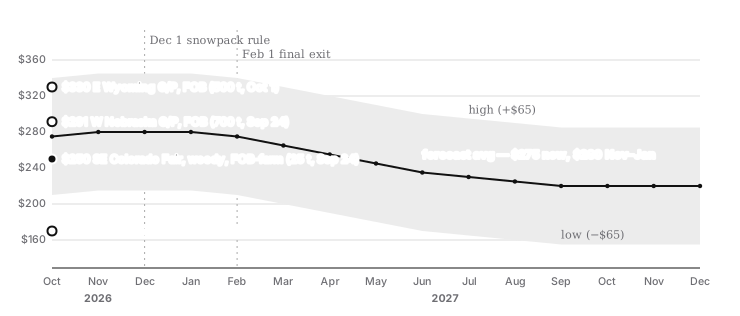
The forecast
| Month | Low | Mid | High |
|---|---|---|---|
| Oct 2026 | 210 | 275 | 340 |
| Nov 2026 | 215 | 280 | 345 |
| Dec 2026 | 215 | 280 | 345 |
| Jan 2027 | 215 | 280 | 345 |
| Feb 2027 | 210 | 275 | 340 |
| Mar 2027 | 200 | 265 | 330 |
| Apr 2027 | 190 | 255 | 320 |
| May 2027 | 180 | 245 | 310 |
| Jun 2027 | 170 | 235 | 300 |
| H2 2027 | 155–165 | 220–230 | 285–295 |
Three layers, shown separately. (1) Today: the rounded middle ($273.5) of eight ways of averaging the regional sales. (2) Winter: Northeast Colorado big-lot prices rose a median 6% into winter in 5 of 6 past seasons; we cut that to about 2% because local pasture is recovering after the rain (about −$11; Oklahoma/Texas drought is the offset). (3) Spring on: rolls off on the drought outlook and new crop. Layers 2 and 3 are judgment driven by weather, logged as exceptions to our own indicator rule.
Moves it down: a Colorado sale of 500+ tons at or under $240; Kansas or Oklahoma wheat pasture reports after the rain; Nebraska and Wyoming demand going from "moderate" to "light." Moves it up: a Colorado sale of 500+ tons at or above $300; Oklahoma's next report still "calling all hay producers"; Colorado's September state price at or above $260 (Oct 30).
For a seller holding hay
The stack is 2025 carryover in 4x4s, untested. Remaining tons, storage, forage quality and live offers are unconfirmed.
- Look at the stack first. About 13 inches of rain fell at Lamar Airport between July 1 and October 1, about 3 inches of it on Sep 30–Oct 1. If the bales sit uncovered, the outside of every exposed bale has taken weather. Pull probe samples from the outside and the inside separately. We have almost no local price data on weather damage (one same-day comparison, Aug 2025: Fair "bleached" $125 vs Good/Premium $140, different cuttings). Mold or heating can make hay unsaleable to dairies and horse buyers.
- Then test, weigh, and get three bids on the same lot description. Ask for price per weighed ton, quantity, pickup date, loading and payment terms, and convert each offer to net dollars at the stack.
- Reference sales, not values: southeast Kansas Fair/Good 3x4 old crop, 150 t, $125 vs $200 for the same grade in the same report (Sep 15); Southeast Colorado Fair weedy 3x4 new crop, 25 t, $250 at the farm (Sep 24); Northeast Colorado Good 3x4, 2,000 t, $260 (Sep 10); western Nebraska Good/Premium, 700 t, $291 (Sep 24); Oklahoma Good/Premium 4x4, 380 t, $170 (Sep 18). No sale of untested carryover printed, and our evidence on how much a year in the stack costs runs from 0% to −37%. Our judgment, wide on purpose: $200–270 if it tests Good and is sound; $150–240 if Fair or weathered; lower if moldy.
- Holding loses on our numbers. Say a $260 net bid today. Holding to January costs about $10 a ton plus about 3% shrink, so January has to net $278 just to break even. Our estimate rises only $5 by January ($275 → $280), so that $260 bid becomes about $265 in January: about −$13 a ton expected, with ±$65 around it, plus weather risk on an uncovered stack. Selling a meaningful share on a firm bid now beats waiting.
- On the old $180 offer: it is $70 under the only local farm sale this cycle (a weedy Fair new-crop lot), $23 under the Kansas Fair/Good average ($203), and $55 over the Kansas old-crop lot ($125). If the stack is sound and tests Good, competing bids should beat it; if it is old and weathered, $180 may be fair. Test first.
- Exit rules unchanged and senior: Dec 1 basin snowpack at or above normal → sell everything by Christmas; never hold past the Feb 1, 2027 reading.
All charts, forecast comparisons and source data
Conditions behind the price
- Markets: Colorado demand "Good to Very Good," trade "Moderate," premium small squares 25–40¢ a bale higher (Sep 24). Nebraska: buyer inquiry "has soften a little in the last two weeks," diesel slowing buyers. Wyoming: demand "moderate to instances good," most hay moving now was sold earlier. New Mexico: asking prices only. Kansas: the late-September report could not be retrieved; a trade-press reprint says demand stayed strong and inventories kept falling (not checked against USDA). Oklahoma/Texas: Oct 2 reports not yet posted at writing.
- USDA August prices (alfalfa): Colorado $235, New Mexico $285, Wyoming $230, Texas $230, Oklahoma $193, Kansas $127, Nebraska $104; US $206.
- Drought (Sep 29 map, before the storm): improving in Colorado, Kansas, Nebraska, New Mexico and Wyoming; worse in Oklahoma (92% severe or worse, 24% exceptional) and Texas. Pasture rated poor or very poor: Colorado 46% (52% a week earlier), Oklahoma 65%, Wyoming 65%, Texas 59%, Nebraska 43%, Kansas 37%.
- Water: Fort Lyon Canal back on since Sep 21 under its own 1884 right; 405 cfs on Oct 1; June–September diversions still only ~25% of the 2010–25 average. John Martin 22,978 acre-feet and rising (19,412 on Sep 18). Pueblo 157,315 acre-feet.
- Cattle and milk: August feedlot placements lowest for the month since 1996; feeders near $335. Colorado has 7,000 more milk cows than a year ago while Class III milk sits near $15–16.
- Costs: diesel hit a new record $6.529 on Sep 21 and was $6.382 on Sep 28. Dec corn about $5.00. Fertilizer index −9.6% in August.
- El Niño: weekly Niño-3.4 +3.1°C (Sep 23 week); advisory in place; 75% odds of the strongest event since 1950. CPC's outlook leans wet for Oct–Dec and calls for drought removal at McClave. Short-term outlooks lean dry for the next two weeks. No snowpack probability is claimed; only the Dec 1 and Feb 1 readings count.
What we're watching
Oct 5 — Sep 30 week Niño-3.4 (grades #37 on Oct 8) · Oct 8 — Colorado hay report + CPC El Niño discussion (grades #29, #32, #36–38) · Oct 9 — USDA Crop Production re-forecasts hay (grades #39) · Oct 22 — Colorado report (closes #30/#31) · Oct 30 — USDA September prices (#33–35) · Nov 5 — drought map (#45) · Nov 30 — USDA October prices (#40–42) · Dec 1 / Feb 1 — the snowpack exits.
Sources and soft spots: raw files and hashes in data/2026-10-02/. Not retrieved: the Kansas report expected Sep 29, the Oklahoma and Texas reports due Oct 2, (John Martin: the Corps of Engineers report, retrieved later the same morning, shows 20,228 acre-feet at the end of Sep 30; the 22,978 we cite is the state's reading of Oct 2, 8:15 a.m., with the reservoir rising). Futures are delayed quotes from Oct 2, not settlements. The Wyoming 1,600-ton Good lot printed with an identical line on Sep 17 and Oct 1; we count it once. Freight ($3.60/mile all-in) is derived from the DAT linehaul rate and diesel, not published. Whether the McClave seller still holds hay, and in what condition, is unverified.